






































































































































































8 Lower Back Stretches After Sitting All Day: Gentle Exercises for Better Mobility
Author: RVLNSV PRASAD
Updated On: October 2026
About Us
Author Bio
Editorial Policy
Contact Us
Introduction
Sitting for hours can leave your lower back feeling stiff, particularly when you work at a desk, drive for long periods, or spend much of the day using a phone or computer. You might notice discomfort when you stand up, difficulty straightening your back, or a feeling that your hips need to loosen before you can move comfortably.
Lower back stretches after sitting all day may help you move more comfortably, especially when stiffness is related to staying in one position for too long. The goal is not to force your spine into a deep stretch. It is to introduce gentle movement, find comfortable positions, and break up long periods of sitting.
There is no single perfect stretch for everyone. Some people feel comfortable bending forward, while others prefer standing, walking, or gently extending their back. Your response matters more than completing every exercise on a list.
The NHS guidance on back pain recommends staying active and trying suitable exercises, while advising people to stop movements that make their pain worse. The Mayo Clinic’s back-exercise guide, updated July 22, 2026 also demonstrates gentle movements that can be introduced gradually.
This guide explains eight accessible stretches, how to perform them, when to modify them, and how to build short movement breaks into a normal workday. It also explains when back pain needs medical attention rather than another stretching routine.
Quick Answer: What Are the Best Lower Back Stretches After Sitting All Day?
Useful options include the cat-cow stretch, pelvic tilts, knee-to-chest stretch, lower trunk rotation, gentle standing back extension, supported hip-flexor stretch, comfortable hamstring stretch, and an easy walking break.
Start with two or three movements that feel comfortable. Move slowly, breathe normally, and avoid forcing the end of your range. A short walk may be more comfortable than floor stretches for some people.
If a movement increases pain, causes symptoms to spread down your leg, or produces numbness or weakness, stop rather than pushing through it. Stretching is not a substitute for medical assessment when warning signs are present.
Key Takeaways
- Long periods of sitting can coincide with back stiffness, but sitting is not the only possible cause of lower-back pain.
- Gentle movement breaks may be more practical than relying on one long stretching session.
- The best stretch is one you can perform comfortably without worsening symptoms.
- Walking, changing positions, and adjusting your work setup can complement stretching.
- You do not need to force your toes, knees, or chest into a particular position to benefit from movement.
- Persistent, severe, or worsening pain deserves professional assessment.
- New bladder or bowel problems, numbness around the groin, or significant weakness require urgent medical attention.
Why Can Your Lower Back Feel Stiff After Sitting?
Your lower back works with your hips, pelvis, abdominal muscles, and other structures to support everyday movement. When you remain in one position for a long time, you may feel stiff when you first stand up or begin walking.
However, back pain has several possible causes. Muscle irritation, disc-related problems, arthritis, nerve irritation, and other medical conditions can produce different symptoms. You cannot reliably identify the cause from stiffness alone.
The National Institute for Health and Care Excellence (NICE) guideline on low back pain and sciatica recommends considering people’s individual needs and capabilities when selecting exercise programs. That is why a stretch that feels helpful for one person may not be suitable for another.
Does sitting all day damage your back?
Not necessarily. Sitting is a normal activity, and there is no single posture that everyone must maintain all day. The more useful approach is to avoid staying in one position for too long, adjust your setup when possible, and change positions regularly.
A practical starting point is to stand, walk briefly, or change your position when you notice stiffness. You do not need to wait until your back becomes uncomfortable.
Does stretching actually help lower-back pain?
It may help some people, but the results depend on the cause of pain and the type of exercise. Stretching is one option within a broader approach that may include strengthening, aerobic activity, education, and other treatments.
A 2024 systematic review and Bayesian network meta-analysis published in the Journal of Orthopaedic & Sports Physical Therapy examined different exercise types and doses for adults with nonspecific chronic low-back pain. Its findings reinforce that exercise effects depend on the program and outcome being studied; they do not establish one universal best stretch for everyone.
The WHO guideline on chronic primary low-back pain similarly supports a person-centered approach rather than treating one exercise as a complete solution.
8 Lower Back Stretches After Sitting All Day
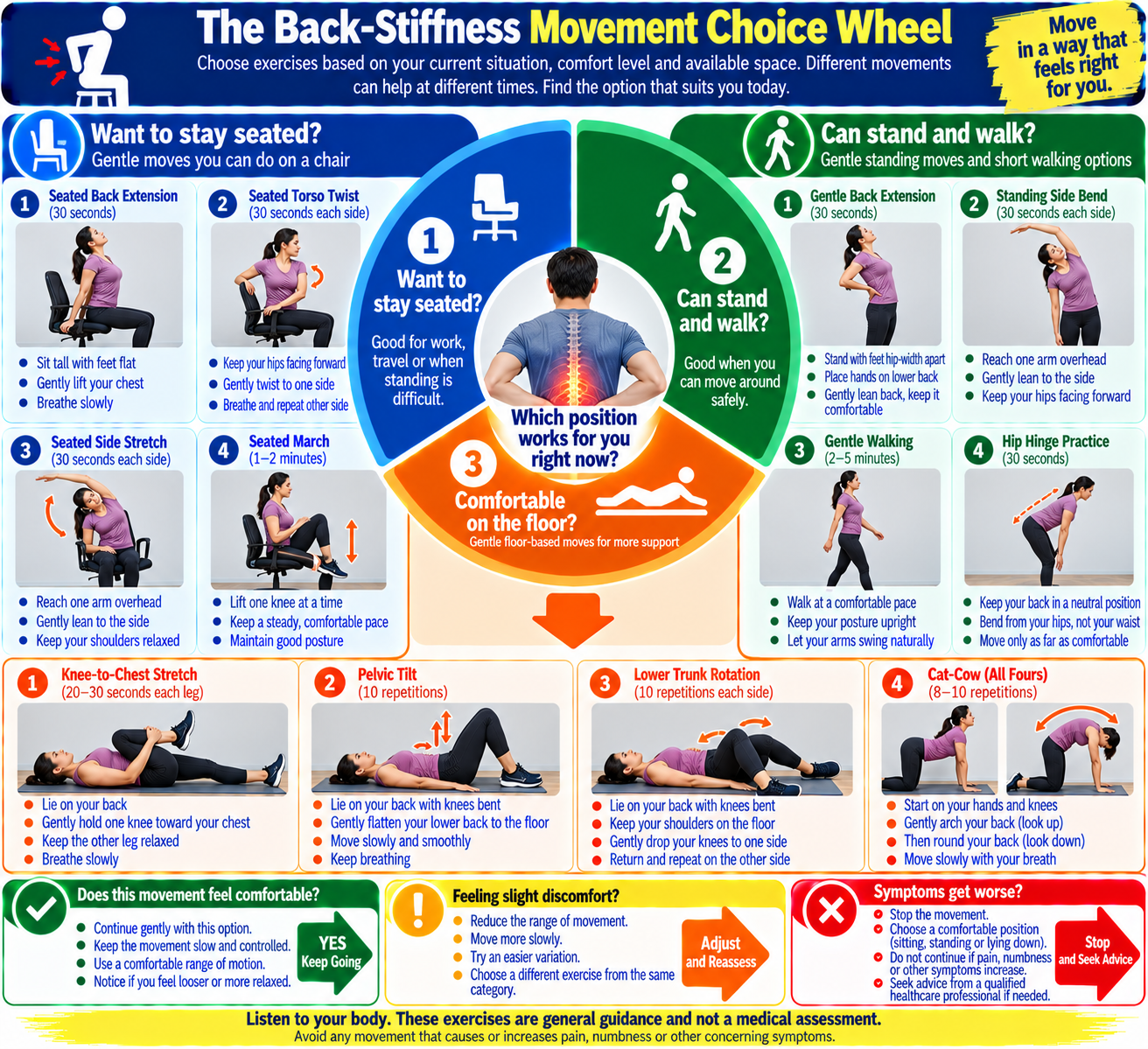
You can try the following movements at home or during a break, provided they are appropriate for your symptoms. You do not need to complete all eight in one session.
1. Cat-Cow Stretch
Best for: Gentle spinal movement and reducing the feeling of stiffness.
The cat-cow stretch moves your spine through comfortable rounding and arching. It can be useful when you want to move your back without holding a deep stretch.
How to do it:
- Begin on your hands and knees, with your hands beneath your shoulders.
- Keep your knees comfortably positioned beneath your hips.
- Slowly round your back upward while allowing your head to relax.
- Return toward a comfortable neutral position, then gently let your abdomen move downward as your chest opens.
- Move slowly between the positions without forcing your spine.
Start with five to eight comfortable repetitions. Coordinate the movement with your breathing if that feels natural.
Common mistake: Moving rapidly between the two positions or pushing into a large arch. A small, comfortable range is enough to begin.
Make it easier: If getting onto the floor is difficult, try gentle pelvic movements while sitting on a stable chair.
2. Pelvic Tilts
Best for: Practicing controlled movement around the pelvis and lower back.
Pelvic tilts involve gently changing the position of your pelvis while lying on your back. They are often easier to control than a deep forward bend.
How to do it:
- Lie on your back with your knees bent and your feet flat on the floor.
- Relax your shoulders and breathe normally.
- Gently tighten your abdominal muscles and tilt your pelvis so your lower back moves closer to the floor.
- Hold for approximately three to five seconds if comfortable.
- Relax and return to your starting position.
Begin with five repetitions and increase gradually if the movement feels comfortable.
The Mayo Clinic’s back-exercise guide includes a lower-back flexibility exercise that uses controlled abdominal and pelvic movement.
Common mistake: Pushing down forcefully or holding your breath. The movement should remain gentle.
Make it easier: Practice a small pelvic movement while seated if lying on the floor is uncomfortable.
3. Single Knee-to-Chest Stretch
Best for: Exploring a gentle hip and lower-back stretch.
Bringing one knee toward your chest may feel comfortable for some people with back stiffness. It is not suitable for everyone, so avoid forcing the knee closer if the movement increases pain.
How to do it:
- Lie on your back with both knees bent.
- Keep one foot flat on the floor.
- Hold the back of your other thigh or your shin, depending on what feels comfortable.
- Gently bring that knee toward your chest until you feel a mild stretch.
- Hold for about five seconds, then release and change sides.
Try two or three repetitions per side. You do not need to pull hard or bring the knee all the way to your chest.
Common mistake: Pulling the knee forcefully or lifting your head and shoulders to reach it.
Make it easier: Use a smaller movement or skip the stretch if bringing the knee upward worsens your symptoms.
The Mayo Clinic’s illustrated instructions for the knee-to-chest stretch provide a useful reference for the starting position and movement.
4. Lower Trunk Rotation
Best for: Gentle rotational movement while lying down.
This exercise allows your knees to move from side to side while your upper body stays relatively still. Use a small range rather than trying to touch your knees to the floor.
How to do it:
- Lie on your back with your knees bent and your feet flat.
- Keep your shoulders resting comfortably on the floor.
- Slowly move both knees a short distance toward one side.
- Return to the center.
- Repeat toward the opposite side.
Try three to five slow repetitions per side. Stop if twisting increases pain or causes symptoms to travel down your leg.
Common mistake: Forcing your knees toward the floor or lifting a shoulder to create a deeper twist.
Make it easier: Move your knees only a few centimeters and pause in the center between repetitions.
The Mayo Clinic’s back-exercise instructions include a lower trunk rotation stretch with a controlled side-to-side movement.
5. Gentle Standing Back Extension
Best for: Changing position after prolonged sitting.
Some people find a gentle backward movement comfortable after sitting. Others may find that extension aggravates their symptoms, particularly when certain spinal conditions are involved. Treat this as an optional movement, not a stretch everyone should perform.
How to do it:
- Stand with your feet about hip-width apart.
- Place your hands on your hips for support.
- Keep your knees relaxed and look forward.
- Gently lean your upper body backward by a small amount.
- Return to standing upright.
Try three to five repetitions if the movement feels comfortable. Do not force a large arch or hold your breath.
Common mistake: Pushing the hips forward and bending sharply through the lower back.
Make it easier: Stand upright, gently move your hips and shoulders, or take a short walk instead.
If backward bending worsens your pain, skip this exercise. A movement break does not have to involve stretching.
6. Supported Hip-Flexor Stretch
Best for: Gently moving the front of the hip after prolonged sitting.
The hip-flexor muscles help move your thigh toward your torso. A supported hip-flexor stretch may be useful if the front of your hips feels tight, although it does not guarantee relief from lower-back pain.
How to do it:
- Stand near a wall or sturdy chair for balance.
- Step one foot backward into a short split stance.
- Bend the front knee slightly and keep your torso upright.
- Gently shift your weight forward until you feel a mild stretch at the front of the rear hip.
- Hold for 10–15 seconds if comfortable, then switch sides.
Avoid pushing your hips far forward or arching your lower back to create a stronger stretch.
Common mistake: Taking an excessively long step and forcing the pelvis forward.
Make it easier: Shorten your stance and hold the wall for support.
7. Gentle Hamstring Stretch
Best for: Moving the back of the thigh without forcing the spine.
Tightness in the back of the thigh can affect how comfortable certain movements feel, but it does not necessarily mean that the hamstrings are causing your back pain. Use a supported position and avoid deep forward bending if it aggravates symptoms.
How to do it:
- Sit near the front of a stable chair.
- Extend one leg with the heel resting on the floor.
- Keep your back in a comfortable position.
- Hinge forward slightly from your hips until you feel a mild stretch behind the thigh.
- Hold for 10–15 seconds, then switch legs.
Do not round your back aggressively or pull your toes toward your face.
Common mistake: Reaching for your toes regardless of how your back feels.
Make it easier: Keep the knee slightly bent and reduce the forward movement.
If the stretch produces tingling, numbness, or pain travelling down the leg, stop rather than assuming the sensation is ordinary muscle tightness.
8. Easy Walking Break
Best for: Breaking up sitting and restoring comfortable movement.
Walking is not a static stretch, but it may be a more practical option than floor exercises when you are at work or away from home. Staying active is a key part of many back-pain self-management recommendations.
The NHS back-pain guidance advises people to stay active and continue normal activities as tolerated rather than spending long periods in bed.
How to do it:
- Stand up slowly from your chair.
- Walk at a comfortable pace for two to five minutes.
- Allow your arms to swing naturally.
- Use a pace that lets you breathe comfortably and move without increasing symptoms.
- Return to your task and repeat a movement break later.
Common mistake: Treating walking as a test of endurance when your back is already uncomfortable.
Make it easier: Walk for one or two minutes, use a shorter route, or change your position regularly if walking is difficult.
If walking makes your symptoms worse, stop and seek appropriate advice if the problem persists.
A Simple 5-Minute Routine for Desk Workers
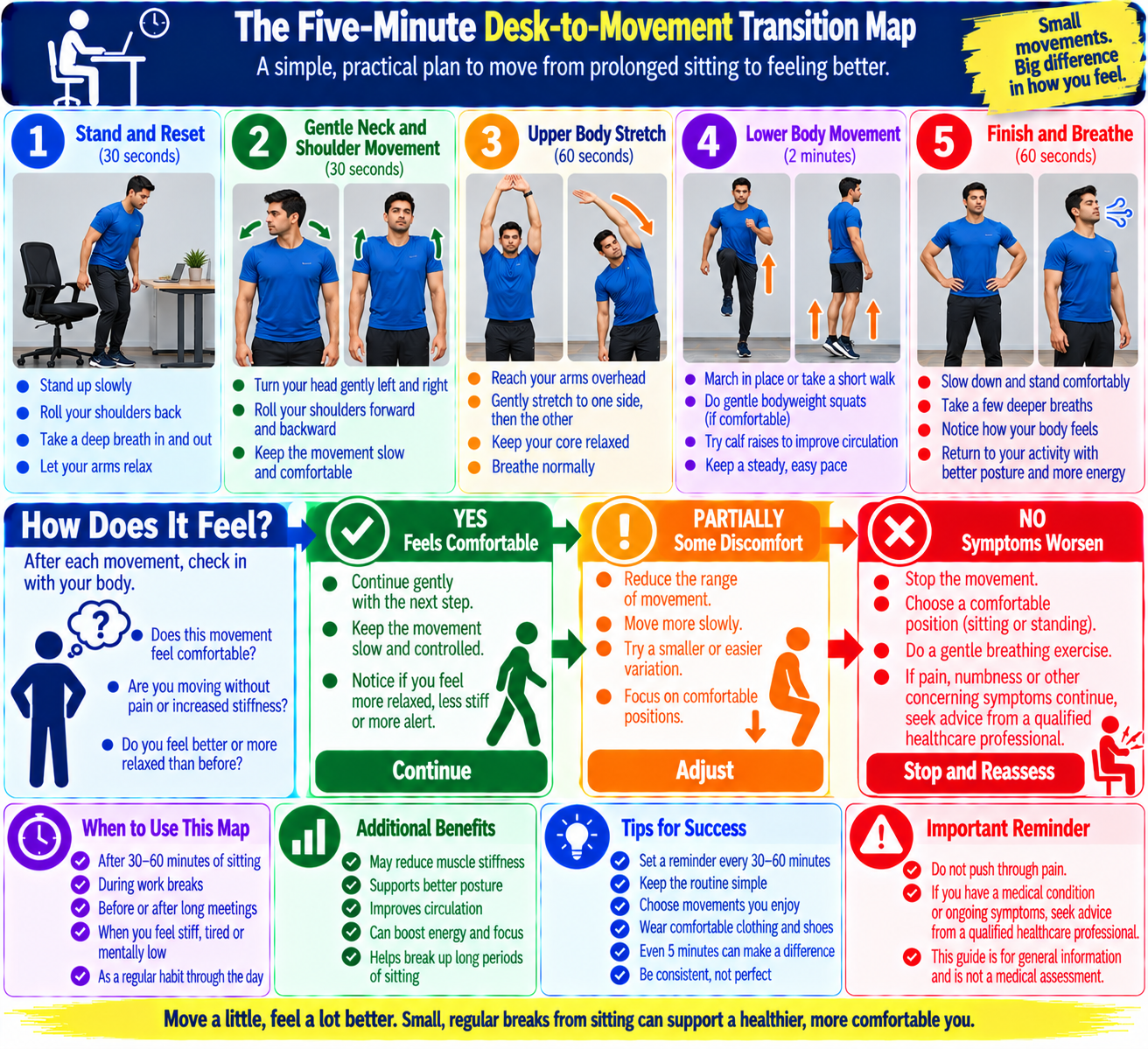
You do not need to perform every stretch during a work break. This short sequence offers a practical way to change position and assess what feels comfortable.
| Time | Movement | What to focus on |
|---|---|---|
| 1 minute | Easy walking | Relaxed, comfortable movement |
| 1 minute | Standing hip movement | Gentle movement without forcing a back arch |
| 1 minute | Seated pelvic tilts | Small, controlled movements |
| 1 minute | Supported hip-flexor stretch | Mild stretch at the front of the hip |
| 1 minute | Easy walking or comfortable standing | Return to movement without rushing |
This is a practical example, not a clinically validated treatment protocol. You can change the order, shorten the sequence, or omit any movement that does not suit your symptoms.
For people who spend much of the day at a computer, several short movement breaks may be easier to maintain than one long session at the end of the day. Set a reminder if you regularly lose track of time while working.
How Often Should You Do Lower Back Stretches?
There is no universal schedule that suits every cause of lower-back pain. If you are generally healthy and the movements feel comfortable, you can try brief movement breaks throughout the day and a short stretching routine when needed.
Start with a few repetitions rather than a large number. Increase gradually only when you can perform the movements comfortably.
| Your situation | Practical starting point |
|---|---|
| Mild stiffness after sitting | Stand, walk, or change position regularly. |
| A stretch feels comfortable. | Repeat a few controlled repetitions. |
| Symptoms increase during a movement. | Stop that movement and try a gentler option only if comfortable. |
| Pain keeps returning. | Consider an assessment by a qualified healthcare professional. |
| Back pain is severe or worsening. | Seek medical advice rather than relying on stretching alone. |
The WHO’s guidance on chronic primary low-back pain supports structured exercise and education as possible components of care, with the approach tailored to the person. It does not prescribe one daily stretching routine for all people.
Practical Ways to Reduce Stiffness During a Working Day
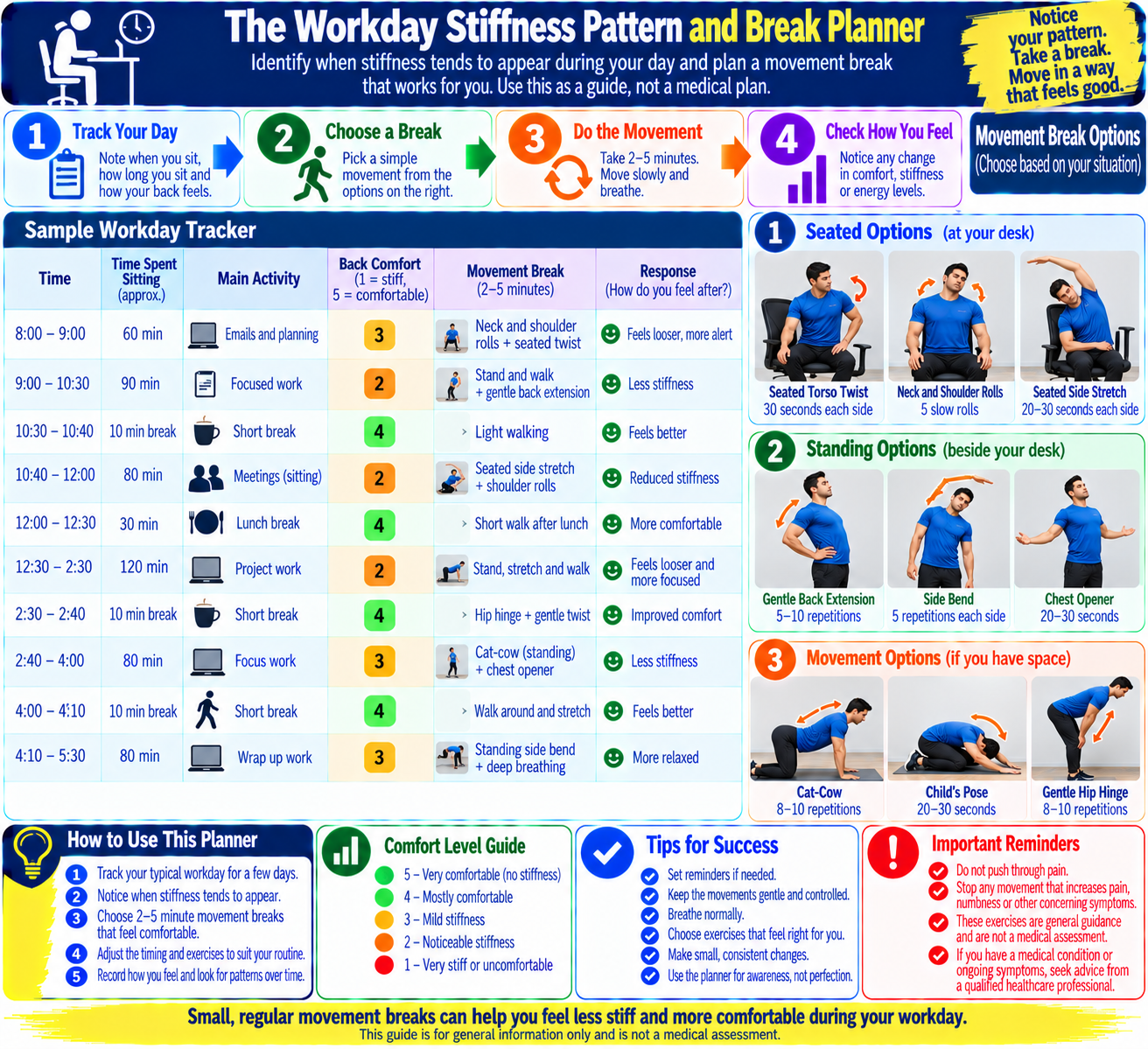
Stretching is only one part of managing discomfort associated with long periods of sitting. These small changes can make movement easier to fit into your day.
Alternate your working positions.
If possible, alternate between sitting, standing, and walking. You do not need to stand all day; prolonged standing can also become uncomfortable.
Keep frequently used items within easy reach.
Position your keyboard, mouse, and frequently used objects so you do not repeatedly twist or reach far from your working position.
Use movement reminders.
A reminder to change position can be more useful than a complicated routine you rarely complete. Start with a break at a manageable interval and adjust according to your workload.
Avoid treating posture as a rigid rule.
There is no single posture that prevents every episode of back pain. Comfort, movement variety, and the ability to change position are more practical goals than holding a perfectly upright position throughout the day.
Consider your sleep and general activity.
Sleep difficulties, stress, and reduced physical activity can influence how people experience and manage persistent pain. The WHO’s guideline on chronic primary low-back pain takes a broader approach that considers physical and psychological aspects of care rather than relying on stretching alone.
Common Stretching Mistakes That Can Make Back Stiffness Worse
Forcing a deep stretch
A stronger sensation is not necessarily better. Forcing your knees to your chest or reaching for your toes can make a movement uncomfortable.
Better approach: Stay within a comfortable range and increase it only if your symptoms allow.
Repeating a movement that aggravates your pain
A stretch that feels good for another person may not be appropriate for you.
Better approach: Stop the movement if pain increases or symptoms spread. Do not keep repeating it to see whether it eventually works.
Assuming every back problem is caused by tight muscles
Lower-back pain can have many causes. A feeling of tightness does not prove that a muscle is shortened or that stretching is the right treatment.
Better approach: If pain persists, returns frequently, or interferes with daily activities, seek a professional assessment.
Staying in bed for too long
Extended bed rest is generally not recommended for routine back pain. The NHS advises people to remain active and continue normal activities as tolerated.
Better approach: Use comfortable movement where possible, while respecting symptoms and any medical instructions you have received.
Ignoring symptoms that need medical assessment
Not all back pain is suitable for home exercise.
Better approach: Learn the warning signs below and seek urgent help when they occur.
When Should You Stop Stretching and Seek Medical Help?
Most ordinary stiffness does not require emergency care, but some symptoms need prompt assessment. Do not use a stretching routine to delay care when warning signs are present.
Seek emergency medical care if back pain is accompanied by:
- New difficulty controlling your bladder or bowel, or difficulty passing urine.
- Numbness around the genitals, buttocks, or the area you would sit on.
- New or significant weakness in both legs, or major changes in sensation.
- Back pain following a serious accident.
These warning signs are described in the NHS back pain guidance.
Seek prompt medical advice if your pain is severe, worsening quickly, accompanied by fever or feeling generally unwell, or associated with unexplained weight loss or a history of cancer. Pain that persists or repeatedly interferes with sleep and normal activities also deserves assessment.
If you have osteoporosis, a recent spinal injury, recent surgery, pregnancy-related concerns, or a diagnosed spinal condition, ask a suitable healthcare professional which movements are appropriate before trying a new routine.
What Recent Research Says About Back Pain and Exercise
Finding 1: Exercise is one part of a broader approach.
The WHO guideline published in December 2023 addresses chronic primary low-back pain and includes education, structured exercise, psychological approaches, and selected other interventions among possible components of care.
What this means for readers: Gentle stretches can be one option, but persistent pain may need a broader plan tailored to your circumstances.
Finding 2: There is no single exercise for every person.
The 2024 systematic review and network meta-analysis in the Journal of Orthopaedic & Sports Physical Therapy evaluated different exercise modalities and doses for nonspecific chronic low-back pain.
What this means for readers: Exercise selection should account for the individual and the intended outcome. It is not scientifically sound to claim that one stretch reduces pain by a fixed percentage for everyone.
Finding 3: Gradual progression matters.
The Mayo Clinic’s July 2026 back-exercise guide recommends beginning with a few repetitions and increasing gradually as exercises become easier. It also advises people starting an exercise program because of ongoing pain or a previous injury to discuss suitable activities with a healthcare professional.
What this means for readers: Start small and adjust according to your response. Completing a long routine is not more important than moving comfortably.
Finding 4: Staying active is generally preferable to prolonged bed rest.
The NHS guidance on back pain encourages normal activity as tolerated and advises against spending long periods in bed for routine back pain.
What this means for readers: If you can move comfortably, gentle walking and position changes may be useful alternatives to repeated stretching.
Frequently Asked Questions
What are the best lower back stretches after sitting all day?
Cat-cow, pelvic tilts, gentle trunk rotations, and a supported hip-flexor stretch are options you can try if they feel comfortable. A short walk or position change may be more suitable for some people.
How long should I stretch my lower back?
Start with a few slow repetitions or a brief hold. You do not need to stretch for a fixed amount of time if a movement is uncomfortable. Gradually adjust the routine according to your response.
Can stretching cure lower-back pain?
No stretch can guarantee a cure. Stretching may help some people with stiffness or nonspecific pain, but the right approach depends on the cause and severity of the symptoms.
Should I stretch if my back hurts?
Not necessarily. Gentle movement may be appropriate for some people, but stop if it worsens your symptoms. Severe, persistent, or unusual pain should be assessed by a healthcare professional.
Is walking better than stretching for a stiff back?
Neither is always better. Walking changes your position and encourages general movement, while stretching targets particular movements and ranges. Choose the option that feels comfortable and suits your needs.
Can sitting all day cause a slipped disc?
You cannot determine the cause of back pain from sitting habits alone. Disc-related problems have multiple contributing factors, and ordinary stiffness does not automatically indicate a slipped disc. Seek medical advice if symptoms persist or you develop pain, numbness, or weakness travelling down a leg.
Should I stretch in the morning or evening?
Choose a time when you can move comfortably and consistently. A short break during the workday may be more practical than waiting until evening, especially if sitting is when you notice stiffness.
When should I see a doctor for lower-back pain?
Seek urgent care for new bladder or bowel problems, numbness around the groin, or significant weakness. Arrange a medical assessment for severe or worsening pain, persistent symptoms, fever, unexplained weight loss, or pain that interferes with daily activities.
Conclusion: Make Comfortable Movement Part of Your Day
Lower back stretches after sitting all day can be a useful way to introduce movement when your back feels stiff. Cat-cow, pelvic tilts, knee-to-chest stretches, and gentle hip movements are options to consider, but no single exercise suits everyone.
Start with a few movements that feel comfortable, avoid forcing your range, and use short walking or position-change breaks throughout the day. If a stretch makes your pain worse, stop rather than pushing through it.
Most importantly, remember that back pain has different causes. Stretching may help some people, but persistent or severe symptoms need appropriate assessment. A practical routine should make movement more manageable, not create pressure to complete every exercise.
Author Note
This article provides general educational information about gentle movement and lower-back mobility. It is not a personalized treatment plan. Any first-person account should be included only if it reflects the author’s genuine, verifiable experience. For additional medical credibility, consider having the final article reviewed by a qualified physiotherapist or healthcare professional.
Medical Disclaimer
This article is for informational purposes only and is not a substitute for medical advice, diagnosis, or treatment. Consult a qualified healthcare professional if you have persistent or worsening back pain, a recent injury, a diagnosed spinal condition, or concerns about whether these movements are suitable for you. Seek emergency care for the warning signs described in this article.
Fitness Disclaimer
Perform movements slowly and within a comfortable range. Do not force a stretch or continue an exercise that increases pain, causes tingling, or produces numbness or weakness. Exercise tolerance varies, and you may need a modified program based on your health, mobility, and symptoms.
Sources
- World Health Organization — Guideline for non-surgical management of chronic primary low-back pain in adults (2023)
- NHS — Back pain: self-care, exercises, and warning signs
- Mayo Clinic — Back exercises in 15 minutes a day (July 22, 2026)
- NICE — Low-back pain and sciatica: recommendations
- Liang et al. — The Best Exercise Modality and Dose for Reducing Pain in Adults With Low Back Pain: A Systematic Review With Model-Based Bayesian Network Meta-analysis (2024)
- WHO — Recommendations for non-surgical management of chronic primary low-back pain
Similar posts
- Active Living
- 4 Best Exercises for Health
- 15 Pilates Exercises for Beginners: A Gentle Start to Core Strength and Flexibility
- 4 Holistic Approaches to Managing Chronic Pain: A Comprehensive Guide
- 6 Home Exercises for Overall Fitness and Flexibility: A Comprehensive Guide
- How to Stay Active While Working from Home: A Comprehensive Guide











[…] 8 Lower Back Stretches That Actually Work for Pain and Mobility […]
[…] 8 Lower Back Stretches That Actually Work for Pain and Mobility […]
[…] 8 Lower Back Stretches That Actually Work for Pain and Mobility […]
[…] 8 Lower Back Stretches That Actually Work for Pain and Mobility […]
[…] 8 Lower Back Stretches That Actually Work for Pain and Mobility […]
[…] 8 Lower Back Stretches That Actually Work for Pain and Mobility […]
[…] 8 Lower Back Stretches That Actually Work for Pain and Mobility […]
[…] 8 Lower Back Stretches That Actually Work for Pain and Mobility […]
[…] 8 Lower Back Stretches That Actually Work for Pain and Mobility […]
[…] 8 Lower Back Stretches That Actually Work for Pain and Mobility […]